
An operation that has sparked conflict and war, cost lives, been embraced as sacred by some religions and persecuted or prohibited by certain rulers. A procedure practised for thousands of years that still divides opinion among doctors and in society. How can such a seemingly simple operation arouse such strong feelings? We are, of course, talking about circumcision.
Its history is as surprising as it is controversial: from pharaohs to sacred texts, imperial prohibitions to medical theories that seem incredible today. Join us for a journey through one of humanity’s oldest operations.
Circumcision involves the partial or complete removal of the foreskin, the skin covering the glans. Here our focus is on history and cultural context; medical indications, benefits and risks deserve a separate discussion.
01One of the oldest recorded operations
Along with procedures such as trepanation of the skull, circumcision is one of the oldest documented surgical interventions. Its precise origins are unknown: we cannot say with certainty when or where it first began.
The practice has been documented or described in societies across Africa, the Near East and Oceania, among other regions. Its meaning has not always been the same. In some communities it may have marked a rite of passage into adulthood, group belonging or ideas about bodily purity. Some have even suggested — as a speculative and difficult-to-prove hypothesis — that in certain settings it might have been used to mark defeated enemies or captives, symbolising subjugation or a kind of “symbolic castration”. There is insufficient evidence to present this last explanation as a proven origin, much less as the universal purpose of the practice. Assigning one purpose to all these traditions would oversimplify a history spanning millennia.[1]
Egypt: evidence from over four thousand years ago
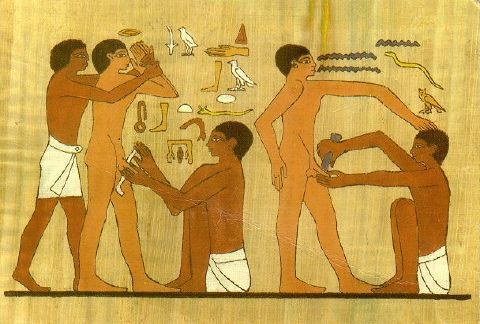
One of the best-known ancient visual records comes from the tomb of Ankhmahor in Saqqara, usually dated to around the 23rd century BCE. Its relief includes scenes traditionally interpreted as circumcisions, although aspects of their meaning and the technique depicted remain under discussion.
We do not know exactly who underwent circumcision in ancient Egypt or why. Suggested explanations include social standing, ritual purposes and preparation for religious roles. There is also a fascinating mythological reference: in the Book of the Dead, blood is said to flow from the genitals of the god Ra after he wounds himself. Some Egyptologists have interpreted this as an allusion to Ra circumcising himself, although that interpretation is not beyond dispute. It is a religious narrative, not a surgical description. The Saqqara relief nevertheless illustrates the great antiquity of the practice.[11]
When circumcision became a political issue
The foreskin also became a marker of identity and, at times, a source of persecution. In the second century BCE, the Seleucid ruler Antiochus IV Epiphanes banned several Jewish practices, including circumcision. These policies helped trigger the Maccabean revolt in 167 BCE.
There were also tensions in the Roman Empire. Whether Hadrian prohibited Jewish circumcision remains debated among historians; under Antoninus Pius, Jews were expressly permitted to circumcise their own sons. The legal details and chronology matter: there was no single uniform ban across the ancient world.[3]
Nor does the story end in Greece or Rome. In Mongol-ruled China, the emperor Khubilai Khan issued an edict in 1280 prohibiting circumcision and certain dietary customs among Muslim communities. The measures caused tension and persecution; historical sources indicate that the restrictions were lifted years later. The Mongol Yuan dynasty fell in 1368 and was replaced by the Ming dynasty, which initially permitted mosque building and employed Muslims while also enforcing assimilation policies. Some accounts present the circumcision ban as a direct cause of Muslim rebellion and the Yuan collapse, but there is insufficient evidence for that direct causal claim: the dynastic change arose from much broader political, social and military conflict.[12][13]
02Circumcision and religion
Judaism: Abraham’s covenant
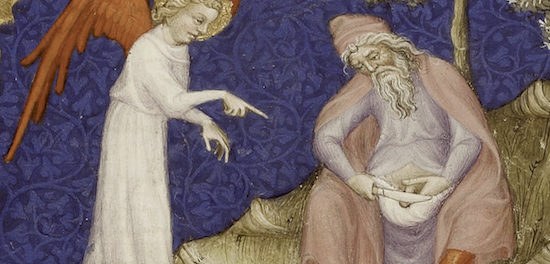
In Judaism, male circumcision is known as brit milah and represents the covenant between God and Abraham. Chapter 17 of Genesis describes the divine promise and sets circumcision out as a visible sign of the covenant:
Genesis 17:4–14 · adapted rendering of the passage“Here is my covenant with you: you shall become the father of many peoples, and kings will come from them. You and your descendants shall circumcise every male; the flesh of your foreskins shall be circumcised, and this shall be the sign of the covenant between us. Every male among you, generation after generation, shall be circumcised at eight days old, whether born in your household or acquired from a foreigner who is not of your line. Any uncircumcised male whose foreskin has not been circumcised shall be cut off from his people, for he has broken my covenant.”[14]
According to the same account, Abraham was circumcised at the age of 99. On that very day his son Ishmael and every male in his household, including children, were circumcised too (Genesis 17:23–27). The biblical text does not specify who personally carried out Abraham’s procedure.[14]
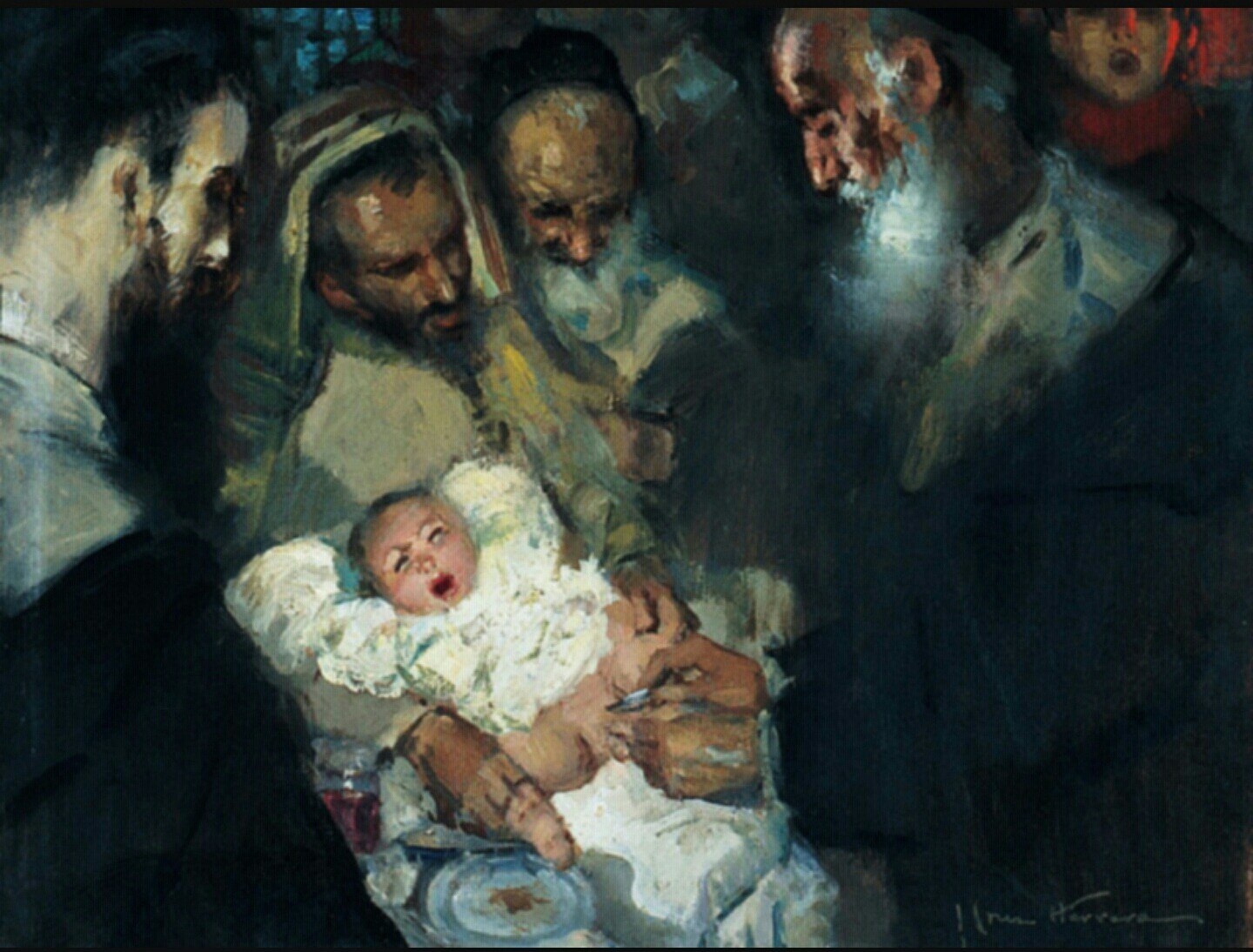
Traditionally the ceremony takes place on the eighth day of life, provided the baby is medically well enough, and is performed by a trained practitioner called a mohel. Family members and blessings are usually part of the ceremony. It remains central to many Jewish communities, although some families and movements reinterpret the custom or choose not to follow it.[4]
Islam: tradition and diversity
Circumcision, often known as khitān, was practised in the Near East long before Islam emerged. The new religion incorporated an existing custom with deep roots in Abrahamic traditions.
Although the Qur’an does not explicitly mention circumcision, the hadiths — reports of the teachings and practices attributed to the Prophet Muhammad — associate it with the sunnah and ritual purity. This continuity points to Abraham and to the same Abrahamic tradition described in Genesis 17; it does not establish that Muhammad instituted circumcision by directly quoting that biblical chapter. Islamic schools of law differ on whether it is obligatory or recommended. There is no universally prescribed age either: the procedure may take place in early childhood or later, and in many communities the occasion is celebrated with the family.[15]
Christianity: is it required?
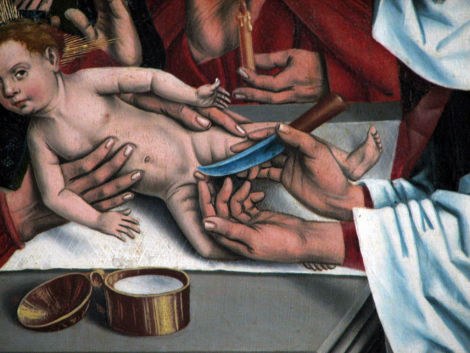
Christianity emerged in a Jewish setting and, according to the Gospel of Luke, Jesus was circumcised on the eighth day. Early Christian communities nevertheless debated whether non-Jewish converts should follow the practice. Circumcision ultimately did not become a general requirement for being Christian.
Some Christian communities, including those in parts of Ethiopia and Egypt, continue to practice circumcision as a cultural or religious custom, while most churches do not require it.
03Four historical curiosities (and an important clarification)
Why is 1 January associated with Jesus’ circumcision?
What if New Year’s Day began because Jesus was circumcised? The dates seem almost too neatly aligned to be a coincidence: if Jesus’ birth is celebrated on 25 December, the eighth day — when, according to Luke’s Gospel, he was circumcised — falls on 1 January. For centuries, Christian churches did indeed mark that day as the Feast of the Circumcision of Jesus. It is tempting to draw a dramatic conclusion: did the Christian calendar begin the moment Jesus was circumcised and named?
Historically, no. The Romans already began their civil year on 1 January before Jesus was born; the practice of numbering years from his birth was devised centuries later. Christian liturgy linked its feast to a date that was already New Year’s Day, but circumcision did not determine the start of our calendar.[9]
The British royal family: an enduring legend
You may have heard that Queen Victoria ordered every male member of the British royal family to be circumcised because she believed they descended from King David, and that Diana, Princess of Wales, ended the tradition. It is a striking story — but the historical evidence does not support it.
Researchers who traced its origins concluded that this was a modern legend, built around reports that some royals, especially the then-Prince Charles, had undergone circumcision. It is a reminder of how a frequently repeated anecdote can come to be treated as a fact.[5]
Why did circumcision become so common in the United States?
How did a ritual operation become a routine feature of many American maternity units? Part of the answer lies in the 19th century, when some physicians claimed circumcision could discourage masturbation, reduce sexual arousal or treat nervous disorders. Those explanations reflect prejudices and medical theories that have since been discredited.
One of its most influential advocates was Lewis Albert Sayre (1820–1900), a prominent orthopaedic surgeon involved in the early development of the American Medical Association (AMA) and its president in 1880. In 1870 he described a five-year-old boy who had severe difficulty walking. Examination revealed genital irritation and a tight foreskin; Sayre performed a circumcision and attributed an observed improvement to the operation. He went on to report other cases involving paralysis or movement difficulties.
Sayre proposed that excessive irritation of the genitals could disturb the nervous system through a reflex mechanism, producing disease in distant parts of the body. By removing the foreskin, he believed he could remove the offending stimulus; such ideas also mingled with contemporary anxieties about sexual arousal. There is no scientific evidence that circumcision is a treatment for paralysis. Yet Sayre’s influence helped spread the procedure as a supposed remedy for an extraordinary range of unrelated diseases.[16]
The resulting cultural contrast remains striking. In the United States, a study published in 2025 found a circumcision recorded during neonatal hospitalisation in 49.3% of male newborns in the 2022 hospital sample. This is not the percentage of all US men who are circumcised, and procedures performed after discharge may not be captured. Across much of Europe, by contrast, newborn circumcision is not performed routinely and is relatively uncommon outside particular medical, religious or cultural circumstances; no single figure applies to every European country.[6][17]
The procedure also has a significant commercial dimension: it generates payments to healthcare professionals and facilities. A 2023 US study at one children’s hospital reported median physician reimbursement of $484 for privately insured newborns, versus $78 under public insurance. These amounts illustrate that financial incentives exist, but they do not by themselves show net profit or establish that every circumcision is equally lucrative.[18]
The anatomical detail in Michelangelo’s David
Our chosen cover image contains a fascinating paradox. Michelangelo’s David depicts a biblical hero at the centre of Israelite history, yet the sculpture shows an intact foreskin. Why would a Jewish biblical figure be depicted that way?
Possible explanations concern Renaissance artistic conventions, classical ideals of beauty and the sculptor’s choices. No single explanation has been conclusively established. That is what makes the detail so interesting: art reflects the ideas of its own age, not simply literal history or anatomy.[8]
What about so-called “female circumcision”?
The phrase “female circumcision” has historically been used for a range of very different procedures involving female external genitalia. It is imprecise and can obscure the harm caused.
The World Health Organization uses the term female genital mutilation (FGM) for non-medical injury to or removal of female genital tissues, including removal of the clitoral hood alone (type Ia). These practices have no health benefits and violate the rights of girls and women. They should not be described as medically equivalent to male circumcision.[7]
A story that continues
From ancient Egyptian rituals to present-day healthcare debates, circumcision has been much more than an operation. It has served as a religious symbol, a marker of identity, a cultural custom and a medical procedure in different settings.
In a future article we can look more closely at the clinical questions that still provoke discussion: when is circumcision indicated in childhood? How does it relate to urinary tract infections, HIV or penile cancer? What do professional medical societies recommend?
For an overview of foreskin-related conditions in children, you can also read our information on genital conditions and phimosis.
Sources and further reading
References used to verify historical details.
- Història clínica i cultural de la circumcisió, J Pediatr Surg (2018)
- Circumcisió a l’antic Egipte i la seva interpretació històrica
- Prohibició d’Antíoc IV segons 1 Macabeus
- Brit milà: origen bíblic de la cerimònia
- Tradició de la circumcisió a la família reial britànica: anàlisi històrica (2013)
- Circumcisió neonatal als EUA, JAMA Pediatrics (2025)
- Mutilació genital femenina: definicions i tipus, OMS
- El David de Miquel Àngel i la representació del prepuci
- 1 de gener i l’inici d’any en el calendari romà
- Circumcisió i religió islàmica: diversitat d’interpretacions
- Historical review of circumcision in ancient Egypt
- Khubilai Khan’s 1280 edict: Chinese and Persian historical sources
- Muslims in China during the Yuan and Ming dynasties (University of Washington)
- Genesis 17:4–14 and 17:23–27: covenant and Abraham’s age
- Circumcision, Qur’an and hadith: Encyclopaedia Iranica
- Lewis A. Sayre and treatments for paralysis, Embryo Project Encyclopedia
- Historical comparison of neonatal circumcision in Europe and the US, BMJ
- Insurance coverage and reimbursement for neonatal circumcision in the US, Urology (2023)